






 View in
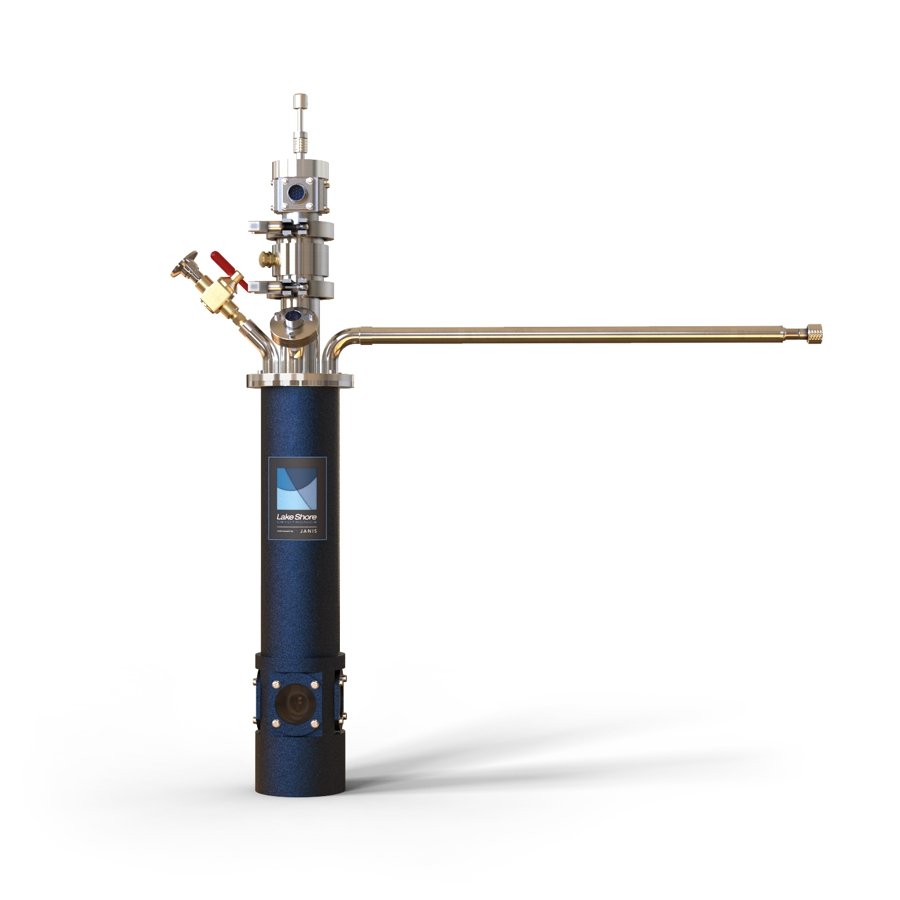
STVP-100 Optical Cryostat
Lake Shore
Optical continuous flow cryostats with three standard sizes available, although, as with all Janis systems, these systems can be customized to suit your experiment. Systems with a 1.5" sample space are in stock for fast delivery.Standard Configuration
Designed for experiments requiring optical access to the sample, the Janis Research STVP-100 includes the following components:• Optical vacuum shroud
• Optical radiation shield
• Four (4) quartz window sets
• Optical sample holder
• Temperature sensor
• Pressure relief valve
• Sample positioner with one (1) 10-pin and one (1) 8-pin electrical feedthrough
• 6' superinsulated cryogen transfer line
• Control heater
• System test
Typical Applications
• Raman Spectroscopy• UV, VlS, IR, FTIR
• Optoelectric Effect
• Photoluminescence
• High Tc
• Microscopy
Specifications
Basic System Specifications - Continuous Flow Cryostats|
Specification |
SuperTranVP |
|
Temperature Range |
<2-325 K |
|
Initial Cooldown Time |
15 minutes |
|
Nominal Temperature Stability (with controller) |
50 mK or less |
|
Orientation |
vertical for <4.5 K |
|
System Weight (without transfer line) |
15 lbs (6.8 kg) |
|
Cryogen Consumption on Cooldown |
0.5L LHe (325 - 4.2 K) |
|
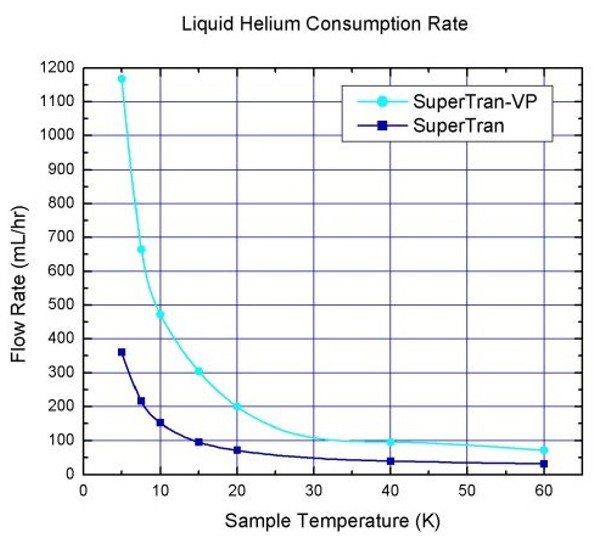
Nominal Cryogen Consumption Rate |
1.3 L/Hr LHe (5 K) |
|
NOTE: Specifications do not include optical or experimental heat loads and assume vertical orientation. |
|
Typical Cryogen Consumption of Optical SuperTran Cryostats
Other Configurations
• Compact vacuum shroud• Customized window materials
• Indium sealed cold windows
• Customized vacuum shroud lengths
• Large diameter sample space (see photo at right)
• Spectrometer mounting flange
• Isothermal zone sample tube (provides uniform sample temperature and enhanced operation with LN2)


